Ever get the feeling your feed is possessed? Come explore the capture and control of attention, perception, and the planet itself during Symposihmm 📡 Capture & Control at A Lab, , and our livestream on Saturday 24 October, 11.00 to 17.00 CEST.
We call AI chatbots spirits and treat algorithms like moody gods, perhaps because a handful of Big Tech companies really do shape what we see and how we think from somewhere out of sight. New media have always come with its ghosts. Philosopher Bernard Stiegler wrote: “in the first photographs, we saw phantoms”. In our high-speed, optic-fiber networked society, the sense that we lack control magnifies. It is not simply that we merely don’t understand these technologies, yet our grasp of them is less important than who runs them. A handful of companies set the terms of what we see. When power hides a blackbox, the vocabulary of secret orders and hidden hands starts to sound less conspiratorial and more like fact.
With our second Symposihmm of the year, Capture & Control, we trace how minds and the planet alike get captured, rendered and steered. How do we make sense of an era this paranoid? Tune in, physically or digitally, for a full day programme with talks, workshops and an exhibition with Daniël de Zeeuw, Noura Tafeche, Sophie Publig & Mikkel Rørbo, and more. Grab your ticket or check out the full programme here.
📚 Resources for the psyoped
Before we spend a Saturday asking who’s behind the curtain, here’s some reading from the people on stage and the people they read (⌐■_■)
○ Daniël de Zeeuw, On Psyop Realism, Cultural Politics (2025). How “it’s all a psyop” turned from a suspicion into an aesthetic, and why the memes doing it also count as media critique. Open access.
○ Trevor Paglen, Society of the Psyop, e-flux (2024). The essay series behind the influence operations line in our event text. UFOs, military deception and the slide from surveillance into psyop capitalism. Start with part one.
○ Sophie Publig & Mikkel Rørbo, Digital Occultism (Aksioma, 2026). Why we call chatbots spirits and memes sigils, and why that language may be the most accurate we have.
○ Noura Tafeche, The Kawayoku Inception. Her archive of almost 30,000 screenshots, memes and posts on cuteness, militarism and the of violence online. Her workshop comes out of this research.
○ Drew Pendergrass & Troy Vettese, Half Earth Socialism (Verso, 2022). Read the book, or play the game.
○ Marina Otero Verzier, "Tuvalu’s digital twin", The Architectural Review (2026). A nation preparing to migrate to the cloud. Can its digital twin preserve statehood?
Speaker Spotlight: Sophie Publig 🔮💻
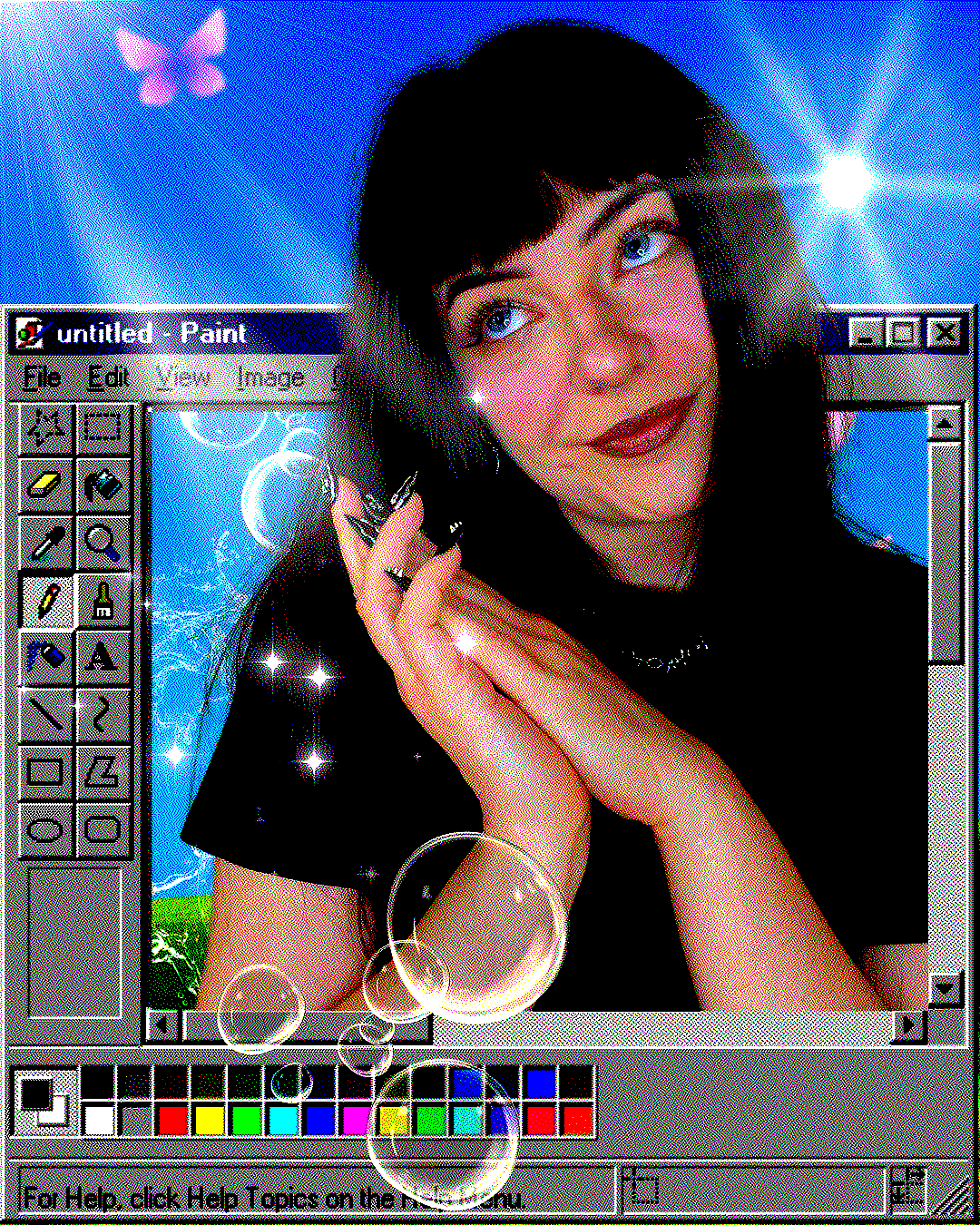
Some archaeologists dig through ruins. Sophie Publig digs through meme ecologies and internet folklore, looking for how platforms make us believe things. A Senior Scientist and lecturer at the Weibel Institute for Digital Cultures in Vienna, she developed the concept of digital occultism with Mikkel Rørbo, now a book with Aksioma, on why chatbots sound like spirits and memes work like spells. She’s also tracing what comes after identity for the Girl Online, and the unconscious that platform cultures leave behind. Ahead of their talk at Symposihmm 📡 Capture & Control, she took on our most pressing questions.
★ How many browser tabs do you have open right now?
I just completed a big writing project, so on my laptop there are only four tabs open instead of the usual 100-150, which is usually when I start purging. On my phone, there are currently 534 tabs open …. ( 𖦹‸𖦹)..
★ What's one piece of the internet you'd want to preserve if the cloud disappeared tomorrow?
Omg absolutely everything?! Internet archaeology is really about preserving as much as possible as any selection would immediately relegate some content to ‘low’ culture while other content basically becomes cultural heritage. I think the more hoarder-oriented approach of saving everything is appropriate as I wouldn’t want to draw that distinction. But it’s also a question of storage: The aforementioned Usenet groups used to be fully archived via Google Groups, but they stopped that service in 2024. Ironically, it is still easier to access the web of the 90s in contrast to anything posted on social media post-2013, as content on these platforms is much more volatile due to auto-deletion, archiving functions, abandoned accounts, and so on.
★ If memes are alive, which one is thriving right now and which one is going extinct?
Great question! I feel like whatever my answer is will be outdated by the date of publication, but I’m really into AI slop, the TikTok Farlands, and basically any pieces of folklore generated by users that create little communities. I feel like there is a lot of creative potential in these communities that we might look back on one day with the same nostalgia we now feel for dank memes or Weird Twitter. It’s true that the life cycles of memes have accelerated significantly since the 90s, with some really only being a thing for a couple of days. One thing I really hope not to see anymore is anyone (especially companies) calling anything ‘so chic’ (。>﹏<)
★ Angelcore, digital saints, swiping right on God: do you pray to the algorithm, bargain with it, or fear it?
I’m definitely more superstitious about the algo than I’d like to be haha. Some time ago, I wanted to show a friend a TikTok of the kind where you ‘choose’ a door to an undisclosed level. While scrolling through my FYP, none of the videos were popping up, so I immediately jumped to the conclusion that they might only show up during nighttime. Of course, that’s an ungrounded assumption, but with us knowing so little about the black boxes of recommendation algorithms, we are compelled to find explanations for their inner workings that might have nothing to do with how they actually function.
Read our full Q&A and follow Sophie Publig on Instagram.
More stuff you should know
🗓 Date: Saturday 24 October 2026
⏰ Time: 11.00 to 17.00 CEST
📍 Location: A Lab, , and our livestream via The Inbetween
ℹ️ Format: A full-day hybrid programme of talks and conversations. Join us in person in or watch from anywhere via The Inbetween.
🎟 Tickets: Onsite €27,50/Student €20/Livestream 7,50.
Want or need to watch from the comfort of your chosen location? All of our events are hybrid so you can also buy a ticket to join Capture & Control via our custom livestream. Check out further accessibility information through the link below.

Capture & Control is part of What Was I Looking at Again?, The Hmm’s broader 2026 year theme, exploring how feeds have reshaped the way we perceive, process, and think about the world.
This programme is kindly supported by the Creative Industries Fund NL, AFK and hosted by A Lab.
You Might Like This: The Hmm goes to Delft on 12 November ᕕ( ᐛ )ᕗ
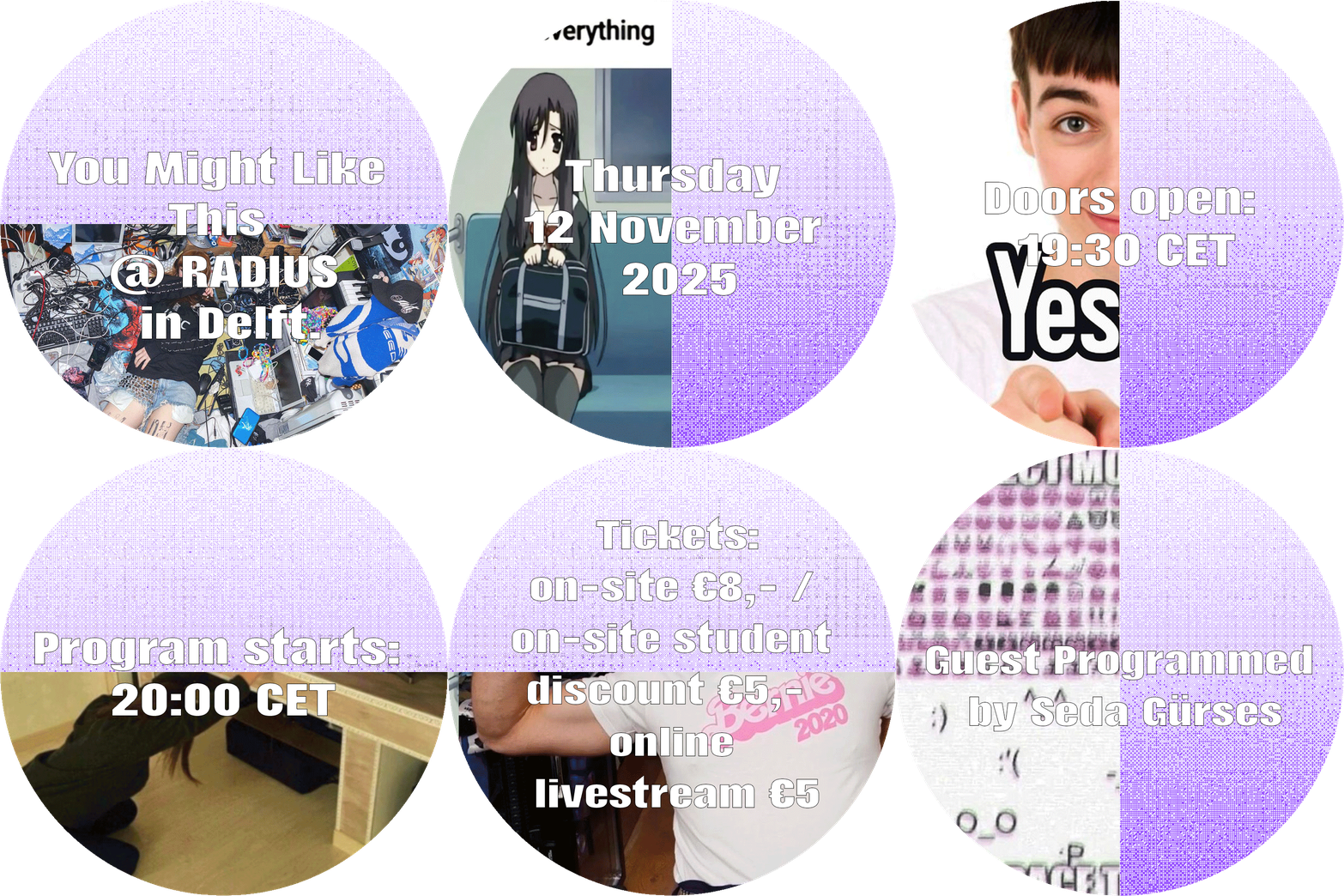
Who decides what you might like? As The Hmm and the algorithmic feed both turn ten, we’re heading to Delft for the first time, alongside six artists, researchers, and makers exploring life inside recommendation systems. It’s our first time in Delft, a city shaped by its technical university. Guest programmer Seda Gürses, Associate Professor at TU Delft, brings her research on privacy engineering, protective optimisation technologies and the politics of computational infrastructure. Mark this date in your calendar. Speaker announcements follow soon (◕‿◕).
Stuff you should know
🗓 Date: Thursday 12 November 2025
⏰ Time: Program starts at 20:00 CET, doors open at 19:30 CET
📍 Location: RADIUS, Kalverbos 20, 2611 XW Delft
🎟 Tickets: on-site €8,- / on-site student discount €5,- / online livestream €5

This programme is kindly supported by the Creative Industries Fund NL and Het Cultuurfonds.
Ai, Ai, Ai: Slopject & Squishies at Dutch Design Week
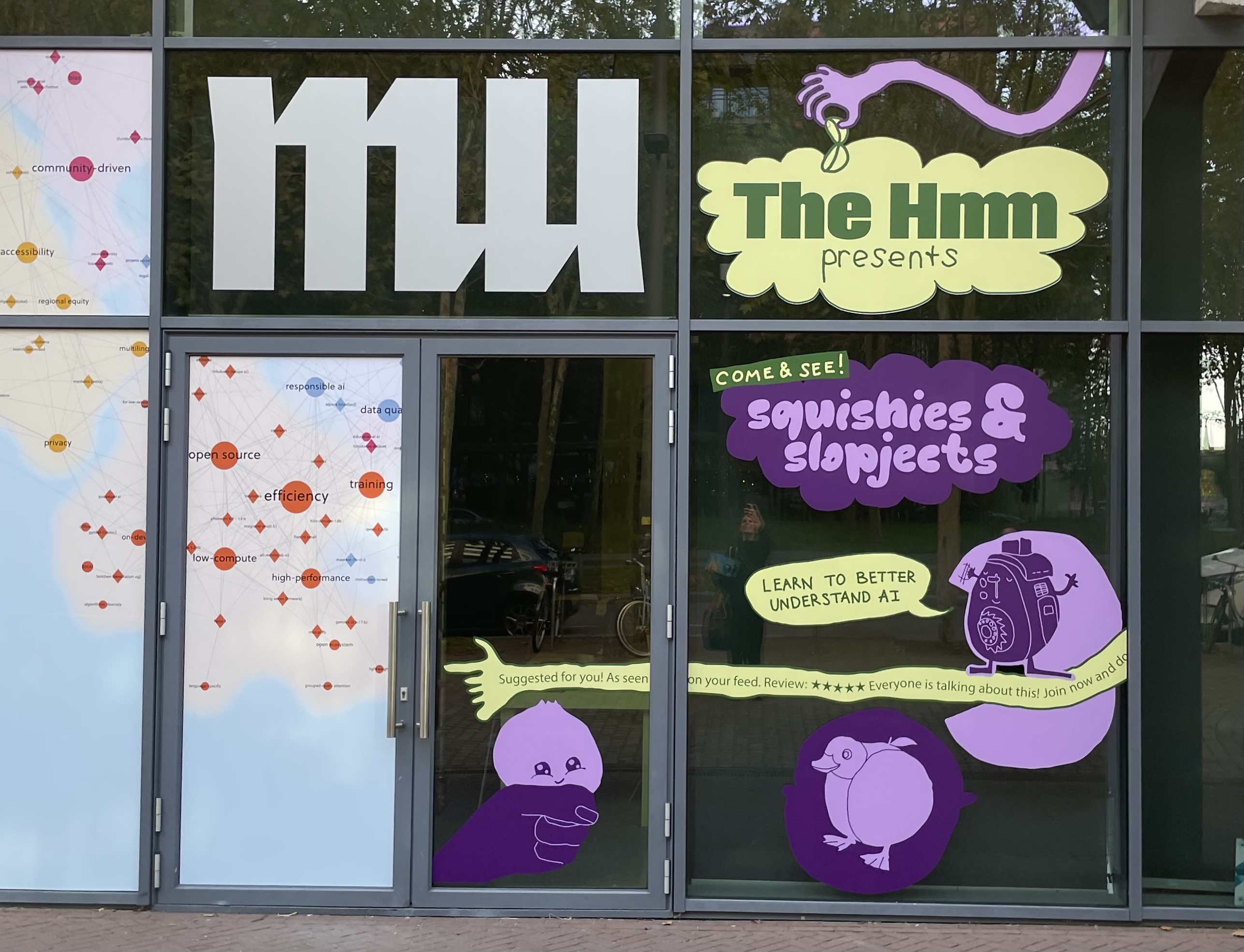
For the third year running, we’re taking the train to Eindhoven. After The Poetics of Prompting in 2024 and last year’s ai, ai, ai lab, we’re back with our friends over at MU Hybrid Art House with two workshops about AI for kids and their grown-ups.
In Make Your Own Slobject, you play the algorithm. Trade your data for a token, draw a stranger’s profile from the ball machine, and mould the figurine they’d almost certainly buy. Is the deal fair? Up to you. And in Squish the System, you design a paper squishy built to trigger one specific feeling, then work out what it would take to make it go viral. Both workshops are developed with artist and educator Maria Mombers.
Stuff you should know
🗓 Date: Oct 17 – Oct 25
📍Location: MU Hybrid Art House, Torenallee 40-06, Eindhoven
🎟 Tickets: Free admission
ℹ️ Remark: For children and grown-ups aged 8 and up. Join in whenever you like, every day from 11:00 to 18:00. No need to register in advance.
.jpg)
This programme is kindly supported by Het Cultuurfonds and the city of Amsterdam.
Trick or treat the algorithm with us The Hmm @ Brainwash Festival on Friday 31 October at Tolhuistuin, Amsterdam.
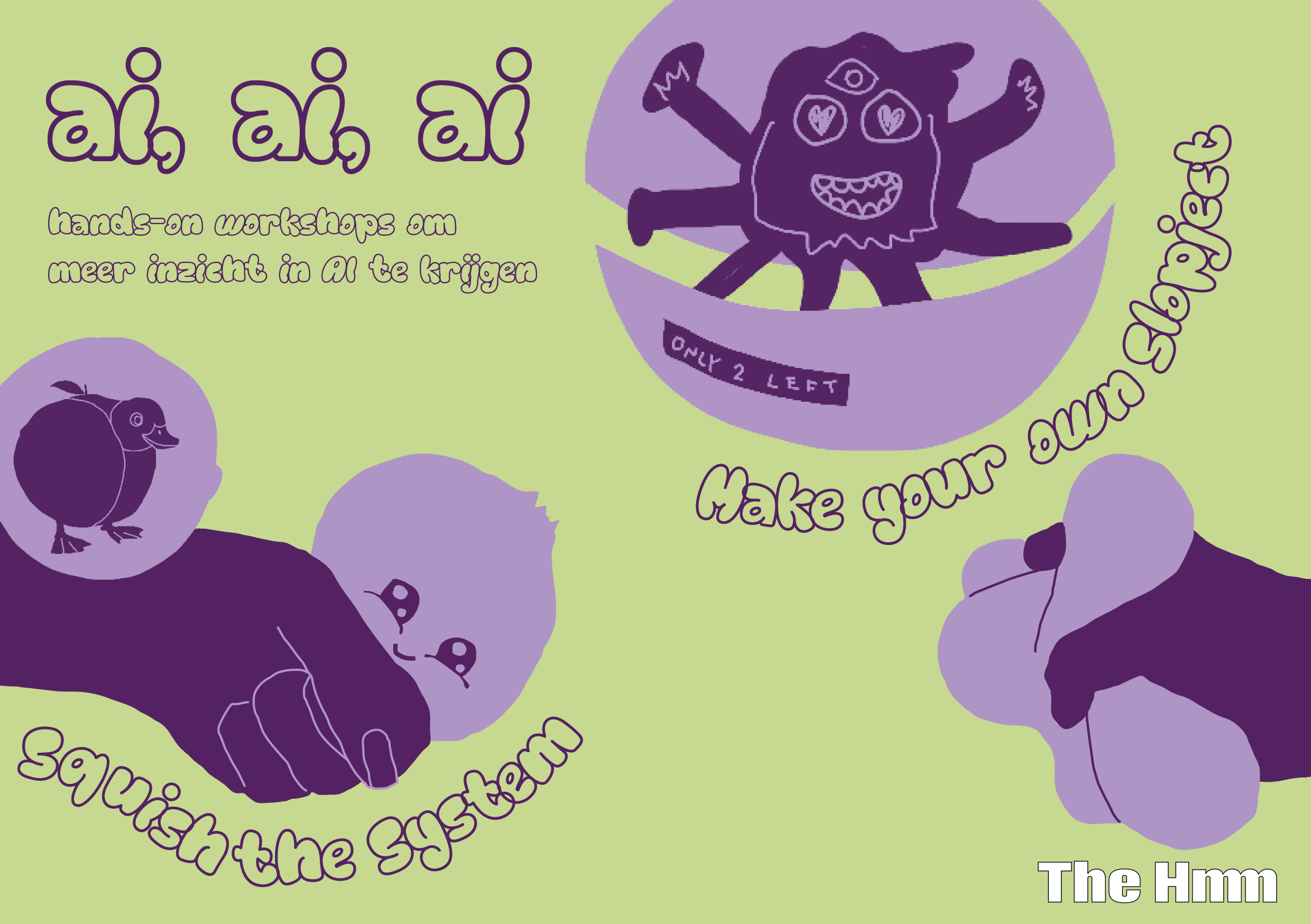
Missing us at DDW? On 31 October we’re at Brainwash Festival 2026 in Amsterdam with the same two workshops, where you get to step into the algorithm’s shoes, then squeeze it back. Brainwash Festival 2026 takes up the theme ‘the shape of us’, through which it explores, from different perspectives, what it means to live together.
Stuff you should know
🗓 Date: Friday 31 October 2026
⏰ Time: 19:10–20:10: Make your own Slopject | 20: 30–21:30: Squish the System
📍Location: Tolhuistuin, IJzaal, Amsterdam
🎟 Tickets: via Brainwash

The extension of our educational program ai, ai, ai, with two hands-on AI literacy workshops for children from 9–15 years old, is financially made possible by the Young Netizen Programme of the City of Amsterdam.
Visit your personal preferences page if you'd like to change how you receive this newsletter. Or, if you must, opt-out completely from all future mailings :-(