Events at ROZENSTRAAT: Screening by Zachary Formwalt & Rumiko HagiwaraJoin us this Sunday for a screening of two films by Formwalt and Hagiwara, followed by a Q&A with artist Deniz Buga
Join us this Sunday, April 12, for a screening of two films by Zachary Formwalt and Rumiko Hagiwara.
16.00-18.00h
The screening will be followed by a Q&A, together with artist Deniz Buga.
Scroll naar beneden voor de Nederlandse tekst.
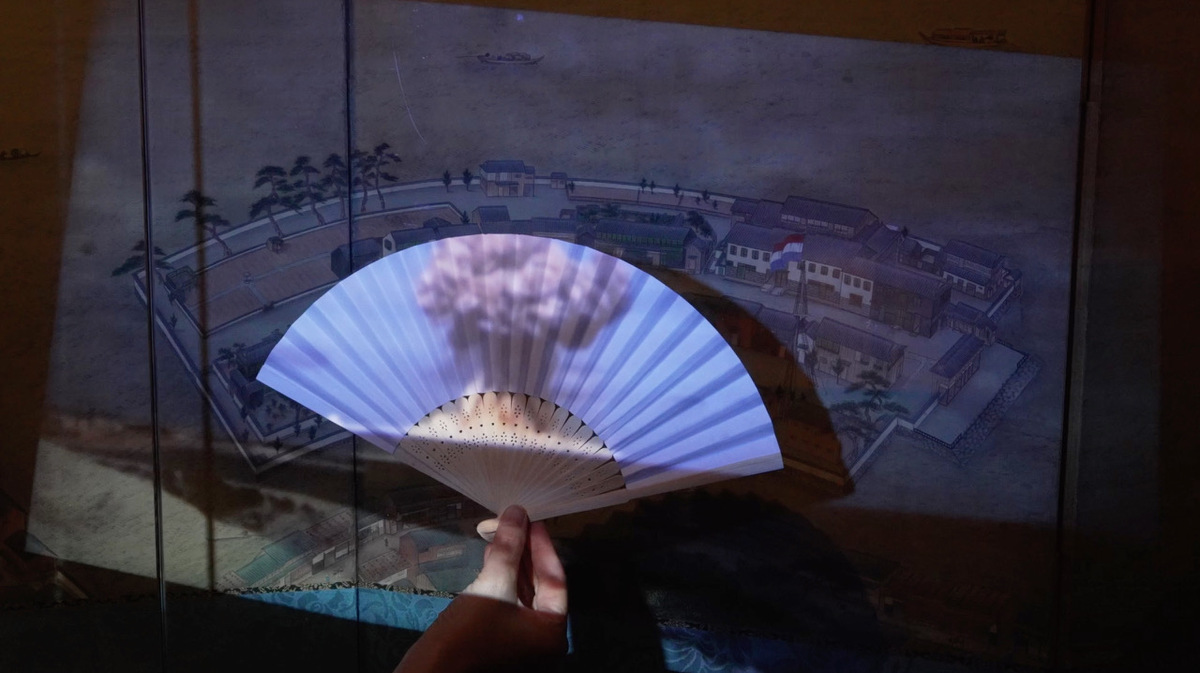
Rumiko Hagiwara, View of Dejima (2025), film still.
Is there any point in trying to grasp the vast, seemingly forces shaping our world from an individual vantage point?
In two recent film works, Zachary Formwalt and Rumiko Hagiwara grapple with this question. In each work, the smartphone appears as a key technological object: the thing that keeps us in step with systems far larger than ourselves, and through which we are ultimately consumed. In dealing with present-day processes, both films point back to historical mechanisms that anticipate our own.
View of Dejima(2025, 20”) A Japanese woman stands before a folding screen at the National Museum of Ethnology in Leiden, studying an image of Dejima — the Dutch East India Company trading post that served as Japan's only opening to the West for over two centuries. The screen is shaped like a folding fan, a detail that becomes a thread. Looking at how the folding hand fan, depicted in Western paintings, functioned as a gendered and racialising screen, Hagiwara draws a line to the displacement at the heart of smartphone production today.
Scenes from a film called "capture"(2025, 23”) A barge of waste drifts across the frame. A ship burns in the Port of Amsterdam while someone types to a friend: "It smells like burnt toast.” “On the other hand,” someone reads in a newly translated classic, “it disrupts the metabolizing that goes on between human beings and the earth”. Scenes from a film called “capture” moves through industrial ports, physiological experiments, and digital interfaces. It searches for sites where movement and metabolism become forms through which life and labor are abstracted into data and value.
We hope to see you on Sunday!
Zachary Formwalt, Scenes from a film called “capture” (2025), film still.
Heeft het zin om als individu te proberen grip te krijgen op de grote, schijnbaar krachten die onze wereld vormgeven?
In twee recente films worstelen Zachary Formwalt en Rumiko Hagiwara met deze vraag. In beide werken verschijnt de smartphone als een belangrijk technologisch object: het apparaat dat ons synchroniseert met systemen die groter zijn dan wijzelf, en waardoor we uiteindelijk worden opgeslokt. Om hedendaagse processen te begrijpen richten beide films zicht tot historische mechanismen.
View of Dejima (2025, 20”) Een Japanse vrouw staat voor een kamerscherm in het Nationaal Etnologisch Museum in Leiden en bestudeert de afbeelding van Dejima — de handelspost van de Nederlandse Oost-Indische Compagnie die meer dan twee eeuwen lang Japan’s enige toegang tot het Westen vormde. Het scherm heeft de vorm van een waaier, een detail dat uiteindelijk een leidraad in de film vormt. Door te kijken naar hoe de opvouwbare handwaaier in westerse schilderijen fungeerde als een genderbepalend en racialiserend scherm, legt Hagiwara verbanden met de hedendaagse productie van smartphones.
Scenes from a film called “capture” (2025, 23”) Een met afval geladen schip drijft door het beeld. In de haven van Amsterdam staat een schip in brand terwijl iemand een bericht stuurt: “Het ruikt naar verbrande toast.” “Aan de andere kant,” leest iemand in een pas vertaalde klassieker, “verstoort het de stofwisseling tussen mens en aarde.” De film beweegt zich langs industriële havens, fysiologische experimenten en digitale interfaces. Het gaat op zoek naar plekken waar beweging en stofwisseling vormen zijn geworden waardoor leven en arbeid worden geabstraheerd tot data en waarde.
We hopen je zondag te zien!
Scenes from a film called “capture” is mogelijk gemaakt met steun van het Mondriaan Fonds.