Vibes for lunch 🍽️
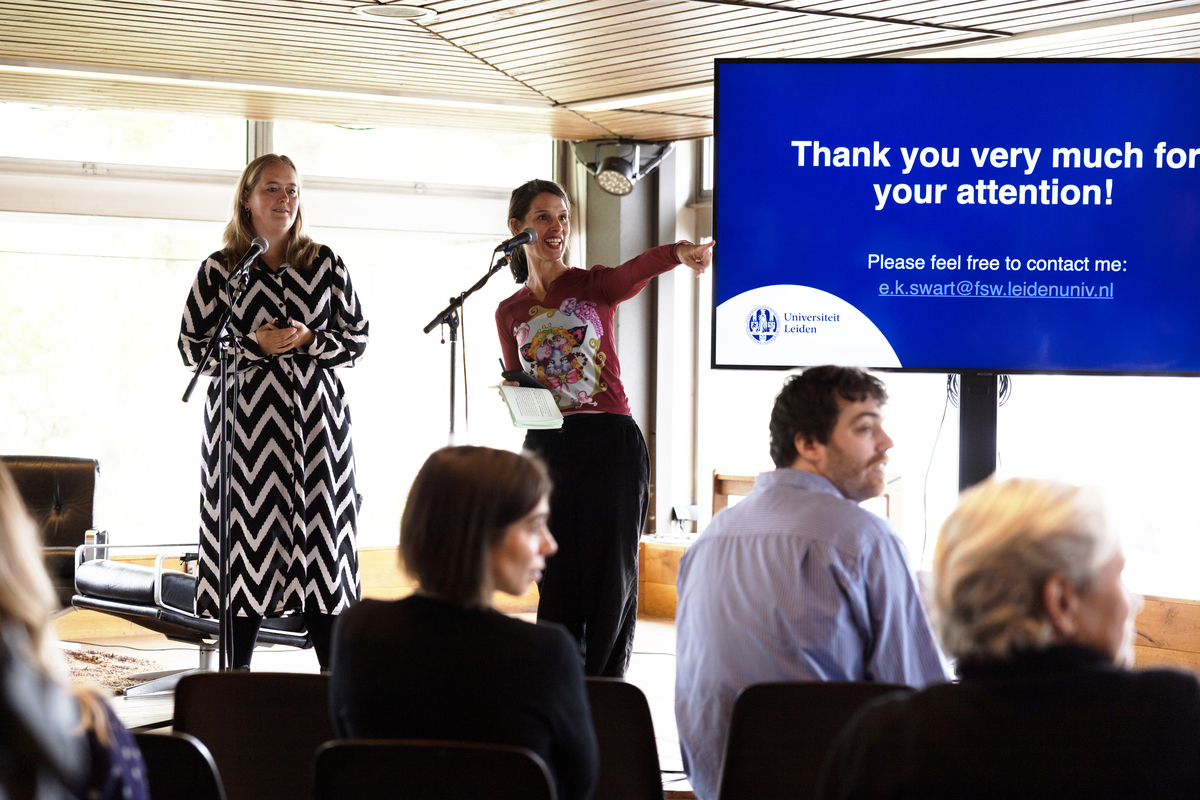
Last Saturday, 16 May, we met at Tolhuistuin and on The Inbetween for our first Symposihmm of 2026, The New Orality. A packed afternoon of thinking out loud about what social media is doing to how we read. We left with a notebook full of hot takes. Read on for what stuck with us.
The problem isn't screens, it's switching.
Elise Swart opened with a reframe: reading survives just fine on e-readers and offline screens. What breaks focus is the open tab next to it. Maybe we're gaining new skills like task-switching, but at what cost?
We're speaking to the apparatus.
Kevin Munger walked us through three media regimes and McLuhan's "global village" as the nightmare he originally meant it as. His sharpest line: "we are speaking first to the apparatus, not each other." The echo is the product.
The mid-afternoon detour.
It wasn't all talks. We spent our afternoon between Gjorgji Despodov's cache-clearing ritual, Max's expedition into the depths of YouTube, Maria Mombers' workshop putting us in the algorithm's shoes, and Jonas Lund's one-on-one FaceTime wellness session – brain rot as guided meditation, very on brand.
Orality was never not literate. It just wasn't European.
Reginold A. Royston gave the day's most necessary reframe, pointing to 17th-century Adinkra ideographs to dismantle the idea that Africa had no writing before European contact. Sound, he reminded us, depends on the memory of the receiver.
Vibes are biopolitical.
In the closing panel, the conversation got denser. Maxime Garcia Diaz talked about making text itself fragmentary to mirror the fragmentary experience of being online, and about the internet as a way to grasp something that otherwise feels too big to hold. Fırat Yücel reminded us that in the Second World War, people went to cinemas to confront war footage together; today, we confront the same kind of imagery alone, in bed, on a phone. The platforms persuade us that this is communal. It's not.
And Sal Hagen and Daniël de Zeeuw landed the day's most uncomfortable line: platforms have adapted to engage us . You have roughly one second to decide whether to keep watching, and most of that decision is happening below thought. People share things not because they think they're true, but because of the reaction they imagine getting. Vibes are a new form of biopolitical control.
Did you miss the talks? Luckily, you'll be able to catch up via our livestream archive on The Inbetween later this summer. In the meantime, read our recap and check out more images from the event. And if you're still into reading after all this, here are some of the texts that came up during the day:
◯ Peli Grietzer, A Theory of Vibe
◯ Reginold A. Royston, Podcasts and New Orality in the African Mediascape
◯ Fauziyatu Moro & Reginold A. Royston, Deep Listening: Podcast Audiences and Affective Resonance in Urban Ghana
◯ Sal Hagen, Daniël de Zeeuw & Tommaso Venturini, Digital Rhythmanalysis
◯ PISA 2022: Performance of Dutch 15-year-olds has dropped drastically
◯ VICE - Gen Z Is the First Generation Dumber Than Their Parents, Neuroscientist Claims
Good vibes only,
◌ ◌ ◌ The Hmm ◌ ◌ ◌
Saturday June 6: Vibe Code Meal Prep @ The Hmm Studio
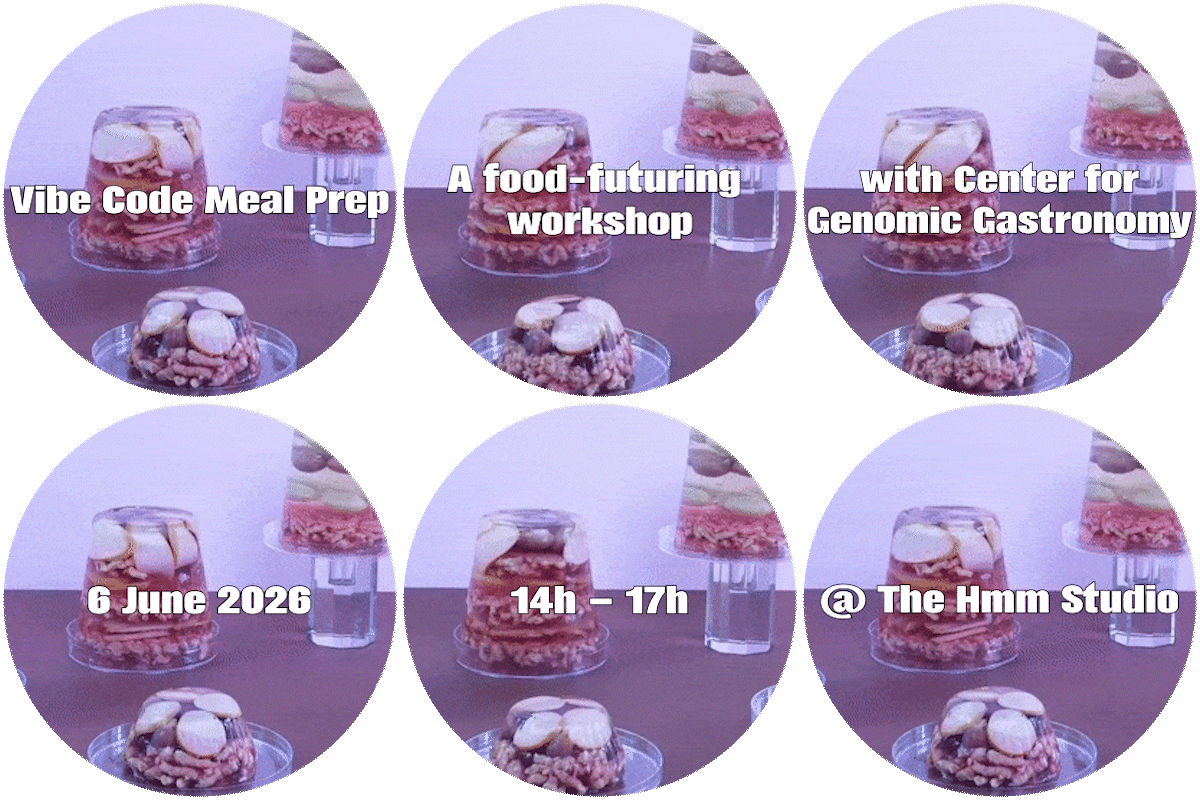
On Saturday 6 June, we're handing the prompt window to the kitchen. VIBE CODE MEAL PREP is a food-futuring workshop at The Hmm studio with the Center for Genomic Gastronomy using prompt engineering and data visualisations to develop hybrid recipes around four trends we've been chewing on: Biomaxxing, Doomer Food, Spice Combinatorics, and . Bring a photo of your fridge and one ingredient that means something to you. Leave with four personalised recipes. No cooking or coding experience needed.
Stuff you should know:
Date: 6 June 2026
Time: 14:00 – 17:00 CEST
Location: The Hmm Studio, NDSM, Amsterdam
Tickets: €12,50 regular, €9,50 students. Limited spots available!

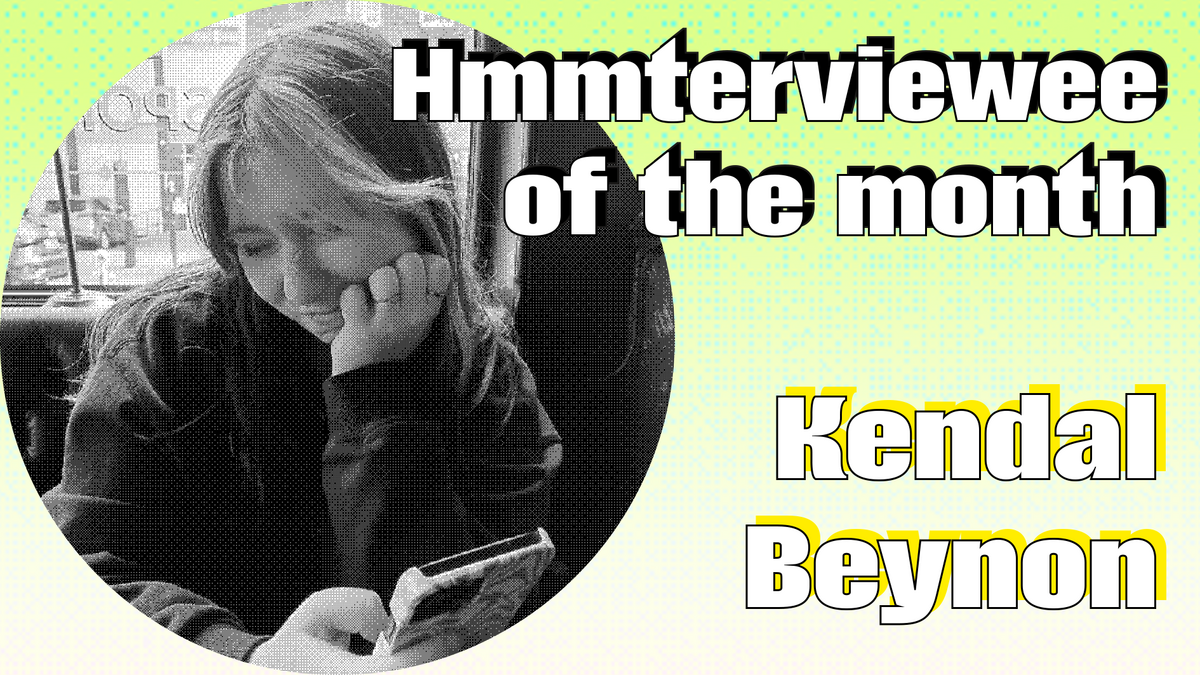
Hmmterviewee of the Month: Kendal Beynon
This month's Hmmterviewee is Kendal Beynon, a UK-born, Rotterdam-based artist and PhD researcher at CSNI in partnership with The Photographers' Gallery, London. Her work lives in the realm of experimental publishing and internet culture, where she sets out to rediscover an alternative online landscape through DIY design, digital folklore, and community building, all while sifting through the ruins of our digital past. She's also deeply embedded in the zine-making community as co-organiser of the zine festival Zine Camp. Read below to find out more about Kendal's thoughts on the internet.
Are there any words or phrases you picked up online that you like to use IRL now?
There are little tidbits from the vine era that are implanted in part of my psyche. Mostly are things that are pronounced stupidly, but to the point that I sometimes forget the actual pronunciations.
Do you have any tricks or methods you use to prevent going on your phone when you don't want to?
I’m a terrible person who spends the majority of her life with her phone on silent and notifications off. I also changed my phone’s display to black and white in a last-ditch attempt to make it less enticing. Fortunately, I can normally excuse excess phone use as one of the many pitfalls of being an internet researcher.
What content can you consume for hours on end?
I’m currently enjoying the subreddit r/goblincore more than I can put into words. There’s something about the whimsy and rejection of being anything other than a goblin that just speaks to me. Another thing I watch a LOT of is videos of people building cyberdecks. I am obsessed with anyone making whimsical tech.
What's an online tool everyone should know about?
I am actually working with some of the lovely people from Creative Crowds on a list of what we call web folklore tools, but if I had to just pick one, it would be https://www.tooooools.app/, it's just a gorgeous lo-fi image and video processor from Daniil Sukhovskoy
You can follow Kendal on Instagram: @tr0pisms.

 Image by Susann Mielke from Pixabay
Hmm-ing in the wild
Come find us at the following events!
◯ until 2 August, Beyond the Manosphere – Masculinities Today @ Stedelijk Museum Amsterdam (hear what we think in the audio tour)
◯ 4 + 8 June - Earthbound Hardware Workshop, in collaboration with Rietveld project Connecting Otherwise
◯ 16 + 17 June - EmojiTalk @ UWV Vakdagen
◯ 6 July - Where does a chatbot live? Workshop by Slow AI and Natalia Stanusch @ The Hmm Studio (more information soon via our socials)
Had a taste and want some more? The Hmm workshops are available to book here.
Activities in the digital field
◯ Open call: Lattice Labs by transmediale (deadline: 7 June)
◯ 4–6 June - Public Spaces Conference
◯ 18 June NADD Archive Day
◯ 24–26 June INC Exit Fest
◯ Open call: Small File Media Festival (deadline: 1 July)
We hope you enjoyed this editorial newsletter! Welcome back, and see you soon!
< ="true">Visit your personal preferences page if you'd like to change how you receive this newsletter. Or, if you must, opt-out completely from all future mailings :-(
